Market intelligence
How we score a market setup 0–100
Jordan Ellis
Senior Product Marketing Manager, CoinBeacon
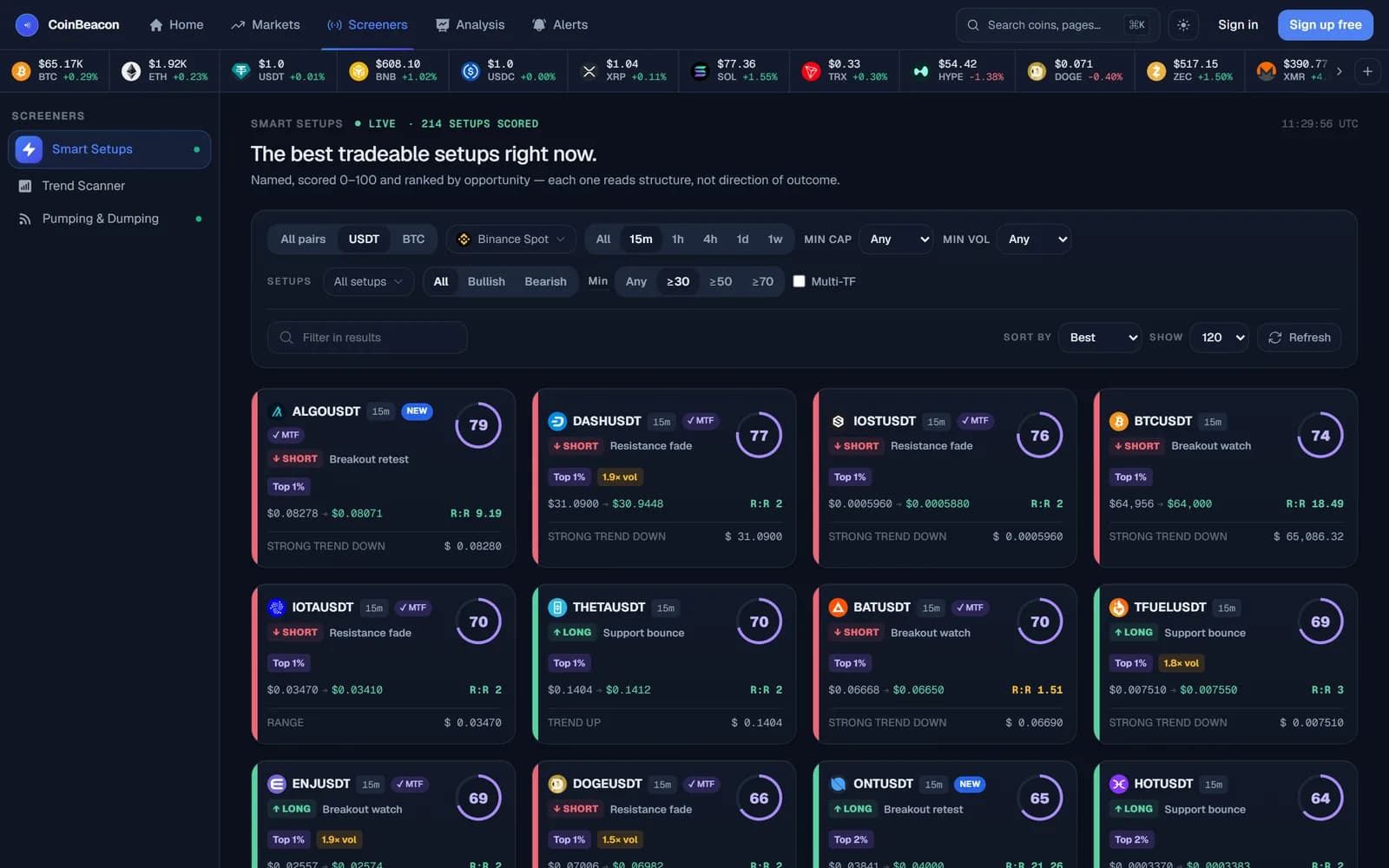
Smart Setups ranks what is happening across a few thousand markets and gives each one a number between 0 and 100. This is what that number is made of — every component, every weight, and the two multipliers that can cut it.
What a setup is, and what we refuse to publish
A setup is a named structure the detectors found on one market and one timeframe: a breakout, a retest, a bounce off a level, a failed break, a trend continuation. The board scores structure, not outcome. It is telling you what the chart is doing, not what it will do next.
It is worth being blunt about the limit before the mechanics. The worker computes an implied trade plan — entry, invalidation, target — and the Risk component scores its geometry. None of it is published. Three fields are stripped server-side for every audience, free or paid, and the win rate is stripped too: the historical track record exists but every one of its routes is admin-only.
The event decides what the trade is
The scorer starts from events rather than from indicators. There are thirteen kinds, each with a base strength: a pattern breakout opens at 100, a breakout retest at 90, a trendline break at 85, a level or trendline bounce at 80, a reversal divergence at 65, a failed breakout at 55, a squeeze at 50, a level test at 40. The strongest one decides what the setup is called; each of up to two others leaning the same way adds ten points.
Two adjustments matter more than the base numbers. Strength halves every five bars and an event older than twelve bars is discarded outright, so the board cannot keep selling you something that happened last Tuesday. And a breakout on dead volume is damped toward half strength, while one that has held for two closed candles is lifted by ten percent — a break nobody participated in is not the same event as a break that stuck.
The arithmetic: five components, two gates
The score is a weighted blend of five components, then two multipliers, then a clamp to 0–100.
- Context — 0.27. How much of the chart agrees with the direction — trend, momentum, volume, structure, volatility.
- Event — 0.27. The strongest thing that actually just happened, plus a bonus for up to two others leaning the same way.
- Participation — 0.18. Relative volume, taker flow and liquidity tier, in a 45/30/25 mix.
- Risk — 0.12. The geometry of the implied plan. The smallest weight, on purpose.
- Alignment — 0.16. Whether the timeframes above this one agree.
The two multipliers are the interesting part. A trend-continuation setup sitting in a range is cut to 75% of its score — but a breakout or a bounce is not, because compression is the condition those setups need rather than a defect. And any market whose last closed candle is more than two timeframes old is halved, which is what keeps a halted or delisted book from sitting at the top of the board on stale prices.
Context is capped rather than summed freely. Evidence is grouped into five categories and no category can contribute more than six units of weight, so a single fact restated six ways cannot carry a score. Full evidence credit is reached at seven weighted signals; below that the component is scaled down, so a setup with one lonely piece of confirmation reads as what it is.
When a component genuinely cannot be measured, its weight is dropped and the others are renormalised — it is not scored at a polite 50. That has one consequence worth knowing: a weekly setup has no higher timeframe to align against, so the Alignment weight is removed and a 1w score is built from four components rather than five. It is on the same 0–100 range as a 1h score, but it is not quite the same measurement.
Five minutes, and only closed candles
Nothing here is streaming. The scheduler runs a fixed five-minute loop, and every detector and indicator reads only candles whose close time has already passed. The public API then serves each query from a 45-second cache.
So the honest worst case, on a 15m board: up to fifteen minutes for the bar to close, up to five more for the next cycle, then the cache and the page poll. A 1d row is scored on a bar that can be twenty-four hours old by construction, and that is not staleness — it is what a daily candle is. If you need tick-level reaction, an alert is the right tool and this board is not.
The coverage number is smaller than “every market” too, deliberately. Three filters run before a symbol can be scored: fewer than sixty closed candles, a stablecoin or fiat base asset, and — for USD-quoted pairs — under fifty thousand dollars of 24-hour quote volume. On the box these figures were read from, Binance’s candle catalogue held 1,362 symbols and the 15m setup index held 1,220. About a tenth of the venue is filtered out before scoring begins.
What we are not claiming
- The score is a ranking, not a grade. Percentiles are computed per venue and per timeframe, within one five-minute pass. An 87 on Binance 4h and an 87 on another venue’s 15m are not the same claim.
- The stable-base filter has a hole we have seen fire. The base asset is derived by stripping known quote suffixes, so a fiat-quoted peg pair can slip through with a base the stablecoin list does not recognise. On one pass a tether/tenge pair was the highest-scoring 4h setup on the board. The mechanism is real and the fix is ours to make.
- Not every advertised venue is equally populated. The scorer accepts six venues; the boards offer five. On the stack these numbers came from, two of them returned no setups at all.
- Almost every threshold here is environment-overridable. The weights, the caps, the event half-life, the volume floor — all of them can be changed on a running instance without a rebuild. The figures above are the code defaults, which is what this site runs.
None of that makes the number useless. It makes it a ranking of structural evidence, computed the same way for every market, that tells you where to look first. That is all it has ever claimed to be, and it is the reason the entry price is not in the payload.