Updated
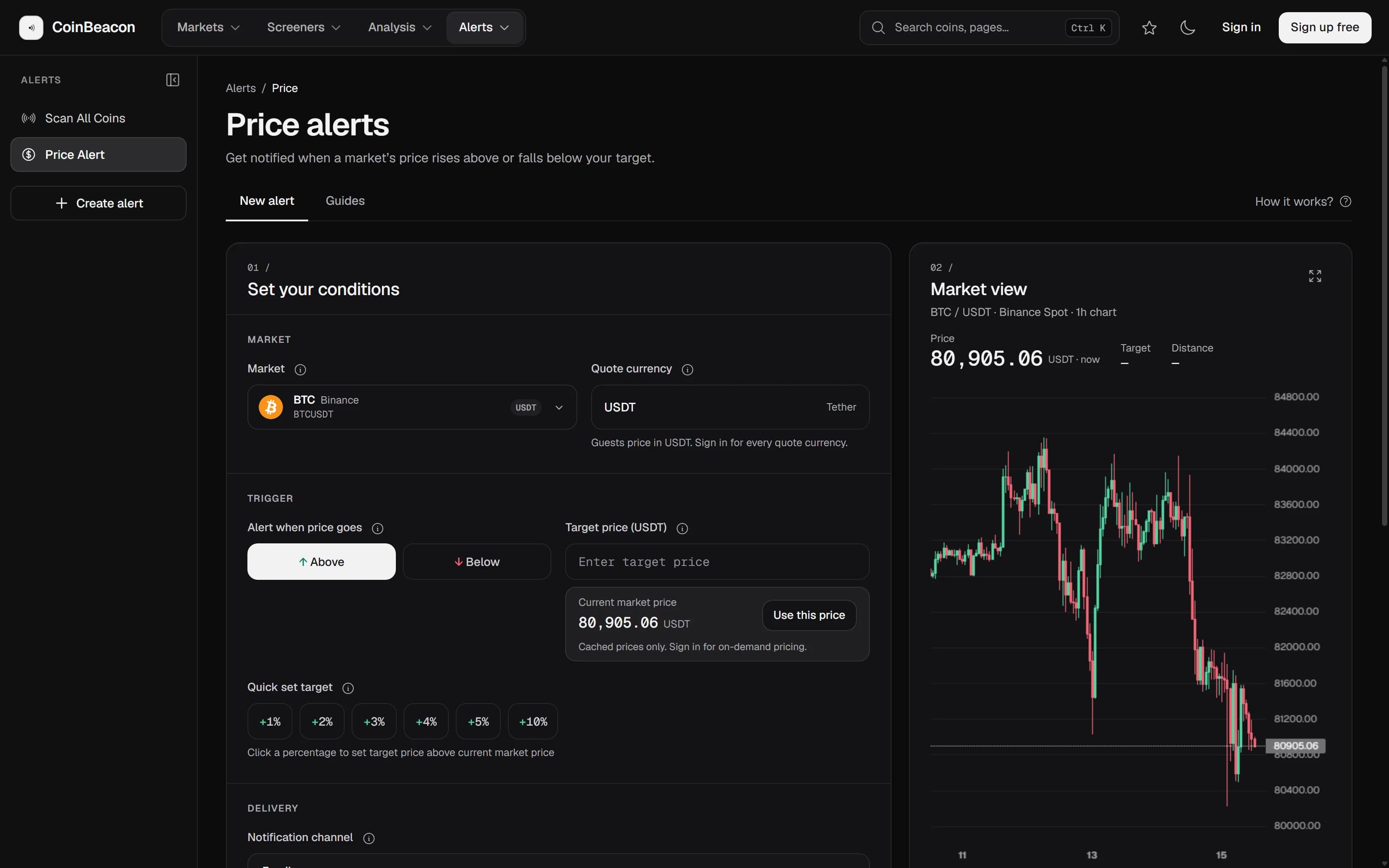
How to set a Bitcoin price alert
Get notified when Bitcoin drops, crosses a price you choose, or simply every few hours. Three alert types, how each one behaves, and which to pick.
CoinBeacon Academy
How to set up alerts that reach you, read funding rates and liquidations, and use each scanner with the exact rules behind it.
Updated
Get notified when Bitcoin drops, crosses a price you choose, or simply every few hours. Three alert types, how each one behaves, and which to pick.
Set up your first crypto price alert, choose where it reaches you, and see why one coin's price differs from one exchange to the next. Step-by-step guides.
Connect the four places a CoinBeacon alert can reach you, what each message looks like, and what happens when a channel stops working.
Why one coin's price differs between exchanges, how far apart prices were across up to 45 exchanges, and what a gap of 0.01%, 0.5% or 50% usually means.
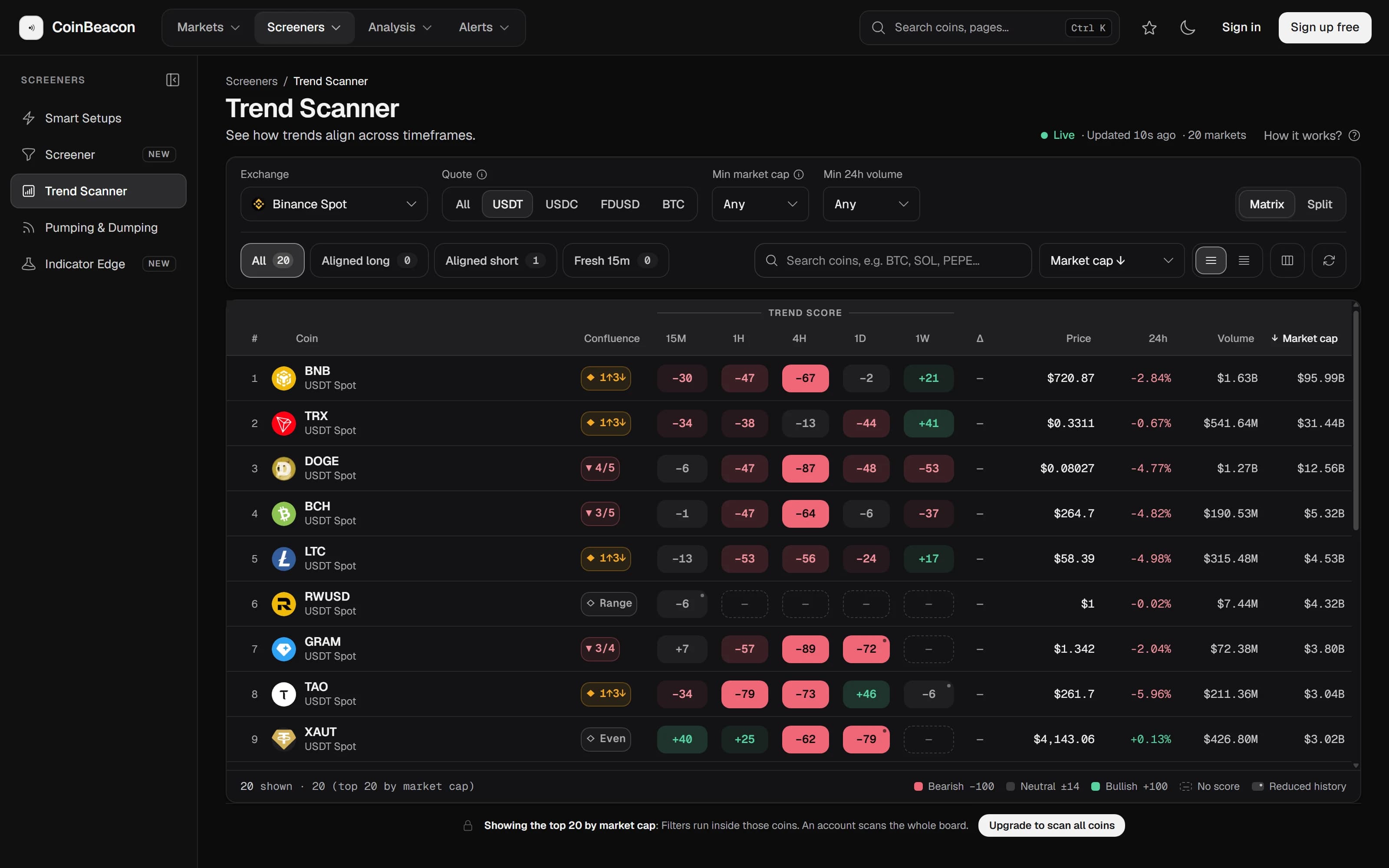
Trend strength, sector momentum and unusual volume are three different signals. How to read each one on CoinBeacon, and what each can and cannot tell you.
How CoinBeacon's scanners find coins that are trending, pumping or dumping, with the exact rules each one uses, so you can judge a signal yourself.
The exact rules CoinBeacon uses to flag a coin as pumping or dumping: the price moves, the time windows, the volume check and the exchanges it watches.
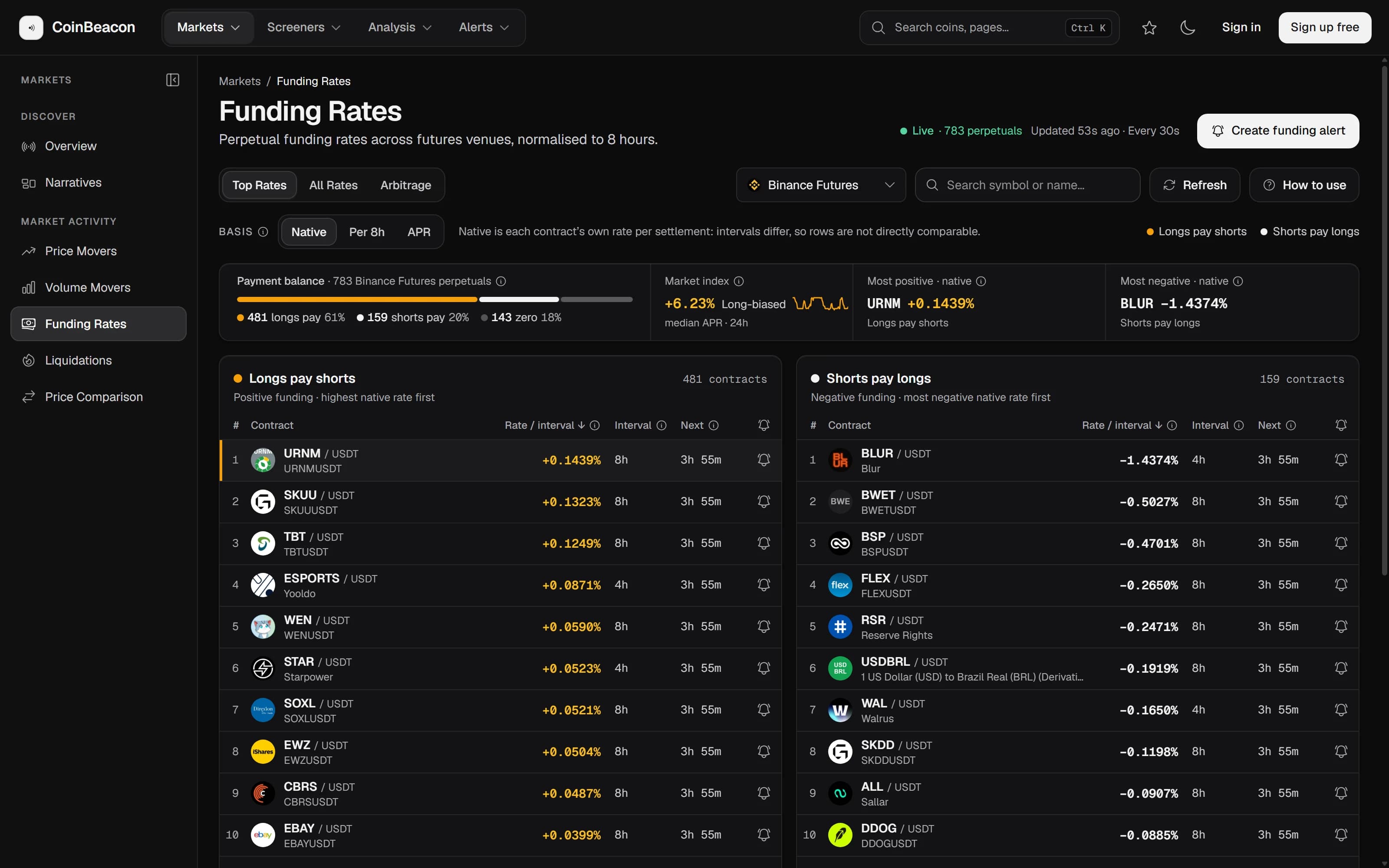
What a positive or negative funding rate means, why the same coin pays differently on each exchange, and how to compare rates fairly across venues.
What funding rates and liquidations say about leverage in the crypto market, how to read them across exchanges, and how to get alerted when they change.
Set an alert that tells you when a perpetual's funding rate crosses zero, on the exchange you trade, delivered to Telegram, Discord, email or a webhook.
Why forced selling feeds on itself, how to see a cascade forming in live liquidation data, and how to get an alert when one starts on a coin you follow.
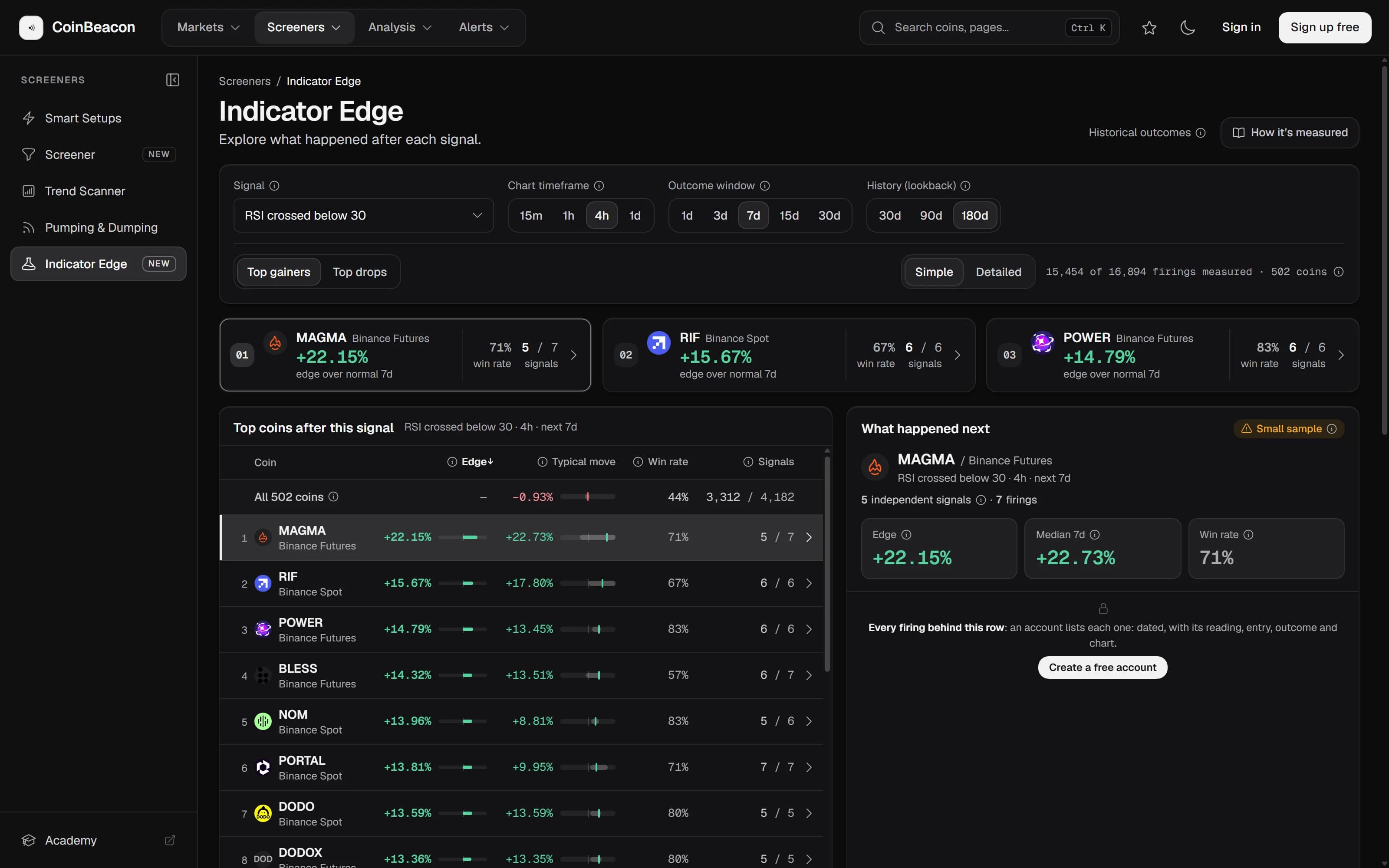
What crypto prices did in the week after RSI crossed 30 or 70, on 737 coins over six months, set against an ordinary week, and how to check any coin.
What prices did after RSI, MACD, Supertrend, moving-average, Bollinger and volume signals on hundreds of coins, measured from CoinBeacon's Indicator Edge.
The week after MACD crosses, Supertrend flips, golden and death crosses and EMA200 breaks, measured on about 800 coins and set against an ordinary week.
What crypto prices did after a candle closed outside its Bollinger Bands, on about 800 coins over six months, with and without a volume spike.
What crypto prices did after a candle traded three times its usual volume, on about 800 coins over six months, split by the way the candle closed.
Every tool these guides describe runs on the live market. Most open without an account; alerts need a free one.