Updated
Why the same coin has different prices on different exchanges
Jordan Ellis
Senior Product Marketing Manager, CoinBeacon
Look up the same coin on two exchanges and the prices rarely match. Most of the time they are a few hundredths of a percent apart; now and then the gap is huge, and a huge gap usually means something other than a bargain. This guide explains why prices differ, and how far apart they were across up to 45 exchanges, measured with CoinBeacon’s price comparison.
Every exchange is its own market
Each exchange sets its prices from trades between its own buyers and sellers, and nothing makes two exchanges agree. They stay close because traders who see a coin cheaper on one exchange buy it there and sell it where it is dearer, which pulls the two prices together. That only happens while a gap is worth closing, so small gaps stay open:
- Fees on both sides. Buying on one exchange and selling on another pays a trading fee twice, so a gap smaller than those fees is not worth closing.
- Moving coins takes time. Doing it again means moving coins or USDT between exchanges, which costs a withdrawal fee and can take minutes or longer, while the gap can close or widen.
- Thin markets move on small orders. On a coin that trades little on an exchange, one order can move its price a long way, and the next trade may not come for a while.
- Prices arrive a few seconds apart. Each exchange reports its price on its own schedule. In a fast market, a price that is ten seconds old already differs from a fresh one.
Two more reasons apply to some markets only: perpetual futures, which are a different instrument from the coin itself, and markets that are not what their ticker says. Both are covered below.
How far apart prices were
CoinBeacon’s price comparison reads every exchange’s latest price for a pair in USDT. The figures below come from it: 177 coins from the top 250 by market value, stablecoins left out, each read six times between 17:24 and 19:09 UTC on 15 October 2026. As on the comparison page at the time, only prices updated in the previous 15 seconds and in line with the other exchanges count.
| Coins | Exchanges | Half within | Within 0.1% |
|---|---|---|---|
| Bitcoin | 41 | 0.015% | 85% |
| Ethereum | 41 | 0.020% | 89% |
| Top 10 by market value (8 coins) | 36 | 0.023% | 90% |
| 11th to 50th (31 coins) | 28 | 0.039% | 84% |
| 51st to 100th (44 coins) | 24 | 0.057% | 74% |
| 101st to 250th (94 coins) | 20 | 0.074% | 63% |
Most exchanges agreed closely. For Bitcoin, half of the 41 exchanges were within 0.015% of the middle price, about $12 at $82,000, and 85% were within 0.1%. Further down the ranking the typical exchange sat further away: for coins ranked 101st to 250th, half the exchanges were within 0.074% of the middle price and 63% within 0.1%.
| Coins | Every exchange | Ten well-known exchanges |
|---|---|---|
| Bitcoin | 0.58% | 0.06% |
| Ethereum | 0.63% | 0.07% |
| Top 10 by market value (8 coins) | 0.56% | 0.08% |
| 11th to 50th (31 coins) | 0.43% | 0.20% |
| 51st to 100th (44 coins) | 0.48% | 0.25% |
| 101st to 250th (94 coins) | 0.55% | 0.35% |
The price gap, cheapest against dearest, stayed around half a percent on every row, between 0.43% and 0.63%. It is set by the single cheapest and the single dearest exchange, and almost every coin has an exchange or two at the edges, often a thin market where the last trade can be many minutes old even though its price arrives on time. Across ten of the best-known exchanges the gap was smaller and grew down the ranking: 0.06% for Bitcoin, 0.08% for the top 10 and 0.35% for coins ranked 101st to 250th.
Since 16 October 2026 the comparison page also sets aside a price that has not changed for 15 minutes or more while the other exchanges moved, so the gaps it shows can be smaller than these.
Spot and perpetual futures
A perpetual future is a contract that tracks a coin without expiring. It trades in a market of its own, and a funding payment between the traders on each side pulls its price back toward the coin’s whenever the two drift apart. During these readings, the perpetuals’ middle price sat 0.04% below the spot middle price for Bitcoin and Ethereum, and 0.07% below for the typical coin. The funding rates guide explains the payment.
The comparison page shows both kinds together under All markets. Spot only and Perpetuals only compare like with like.
When a gap is too big to be true
On 104 of the 177 coins, at least one exchange quoted a price 10% or more away from the others at some point in these readings, and on 31 coins one was 50% or more away. A gap that size would not last between two working markets for the same coin, because traders would close it. When one shows up, it is usually one of these:
- A different token with the same ticker. Tickers are not unique. Two unrelated tokens can trade under the same few letters on different exchanges, at entirely different prices.
- A market that has stopped trading. An exchange can keep showing a market’s last price after trading there has dried up, or while it winds the market down. In September 2026, one exchange that was winding down quoted Bitcoin 2.2% below every other exchange, on a market where the lowest offer to sell sat 7.4% above the highest bid.
- Transfers are paused. When an exchange stops deposits or withdrawals of a coin, nobody can move it in or out to close a gap, and the price there can drift away from the rest.
CoinBeacon’s comparison lists such prices under Out of line, apart from the rest. When a coin has at least four fresh prices, any price more than 0.5% from their middle, or five times their typical distance from it where that is wider, is set aside and cannot be the lowest or the highest. Across these readings it set a price aside 2,418 times: 705 times for a price 0.5% to 2% away, 790 for 2% to 10%, and 923 for 10% or more.
Compare a coin yourself
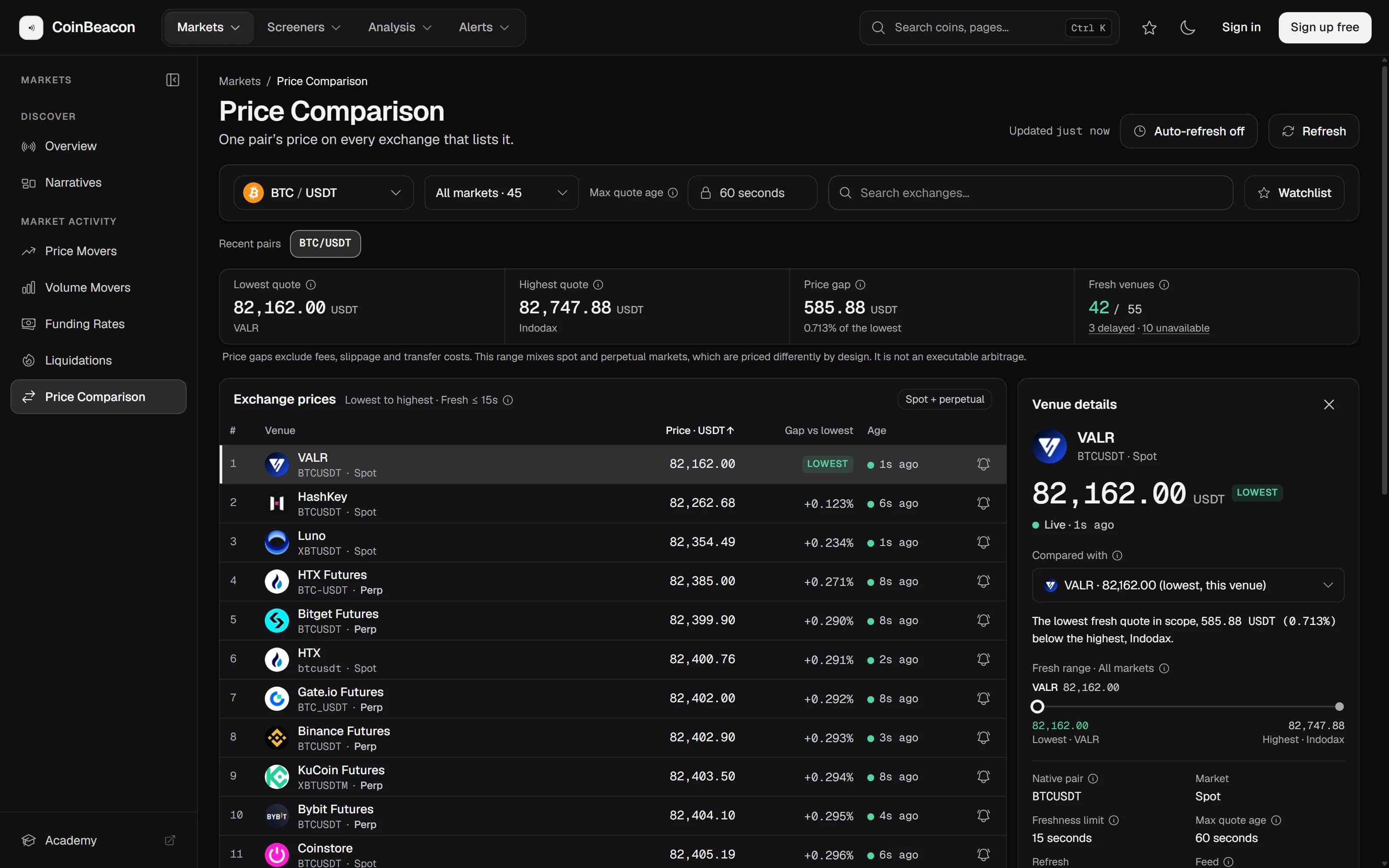
The price comparison, under Markets in the app, shows one pair on every exchange that lists it, with no account needed.
- Pick the coin. Search any coin. The pair is priced in USDT.
- Choose the market scope. All markets mixes spot and perpetual futures; Spot only and Perpetuals only keep like with like.
- Read the summary. Lowest quote, Highest quote, Price gap and Fresh venues. The price gap leaves out fees, slippage and transfer costs, so it is not a profit anyone can take.
- Check what was left out. Delayed quotes (older than 15 seconds), Out of line quotes and Unchanged quotes (the same price for 15 minutes or more while the other exchanges moved) are listed under the table and do not count towards the gap. In these readings a typical coin had one or two delayed quotes.
Which price your alert watches
A price alert watches one exchange: the one you pick when you create it. On a coin whose exchanges disagree, that choice decides when it fires, so pick the exchange you actually trade on. To watch the same coin on two exchanges, create the alert twice. The Bitcoin price alert guide walks through one.