Liquidation cascades explained
Jordan Ellis
Senior Product Marketing Manager, CoinBeacon
A liquidation is one trader’s position being closed by force. A cascade is what happens when those closes push the price far enough to trigger the next ones, and the next, until a move runs much further and faster than any news behind it.
What a liquidation is
A leveraged position is held with borrowed money against collateral called margin. When the price moves against it far enough that the margin can no longer cover the loss, the exchange closes the position at market. A long being liquidated is a forced sell; a short being liquidated is a forced buy.
The higher the leverage, the smaller the move needed. At 10× leverage, a move of roughly 10% against the position wipes out its margin; at 50×, roughly 2%. Exchanges usually liquidate a little before that point.
Why liquidations cascade
Many traders open positions near the same prices and pick similar leverage, so their liquidation prices cluster. When the price falls into one of those clusters, the forced selling from the first liquidations pushes it lower, into the next group’s liquidation prices, whose forced selling pushes it lower again. That is a long cascade, sometimes called a long flush.
The same chain runs upward when shorts are crowded: forced buying lifts the price into the next shorts’ liquidation prices. That is a short squeeze. Either way, the move feeds on itself until the cluster is exhausted, which is why a cascade can overshoot and then snap back once the forced orders stop.
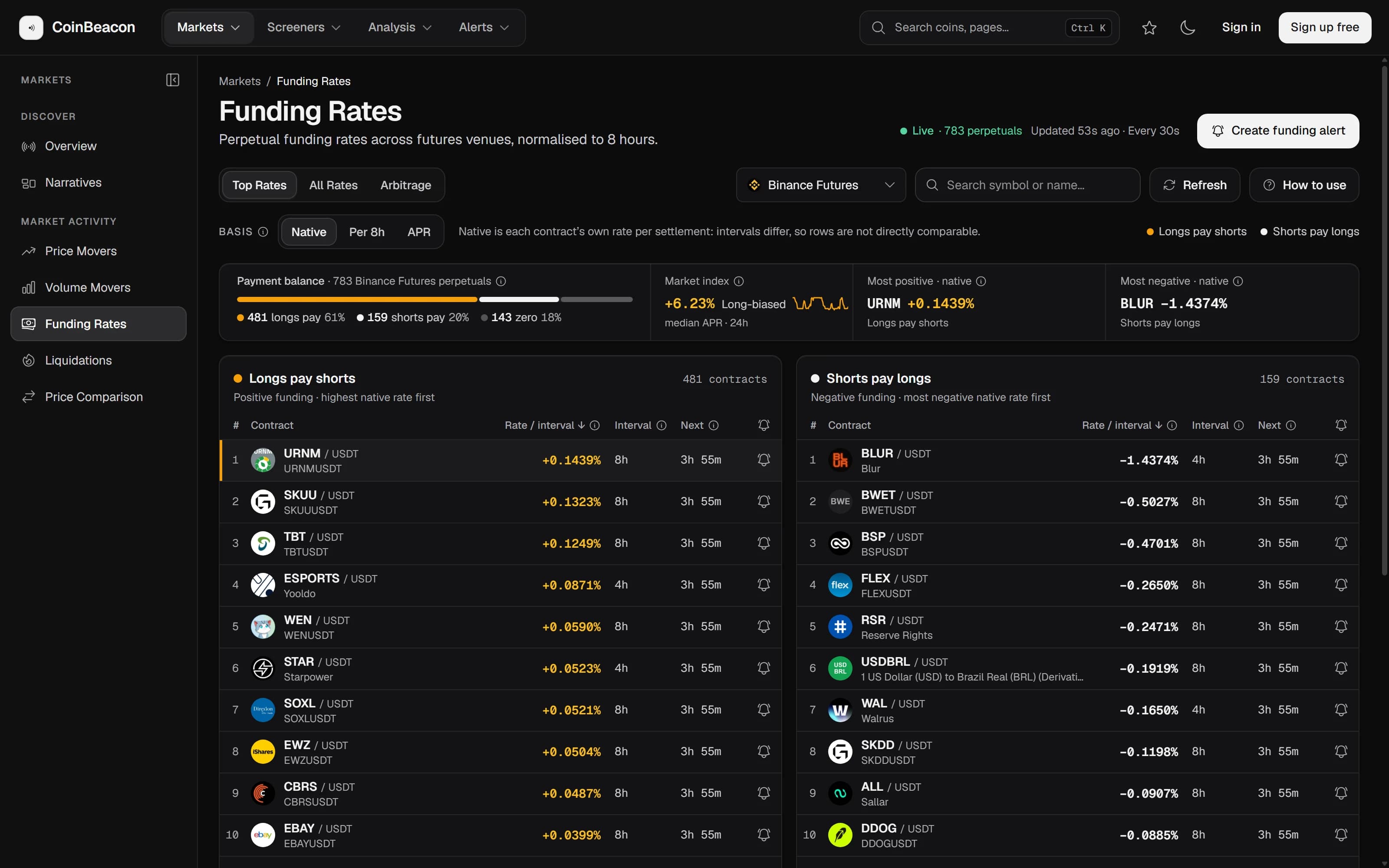
Funding rates are a useful early clue: a market where one side has been paying heavily to stay in is a market with a crowded side to flush. See funding rates explained.
How a cascade is detected
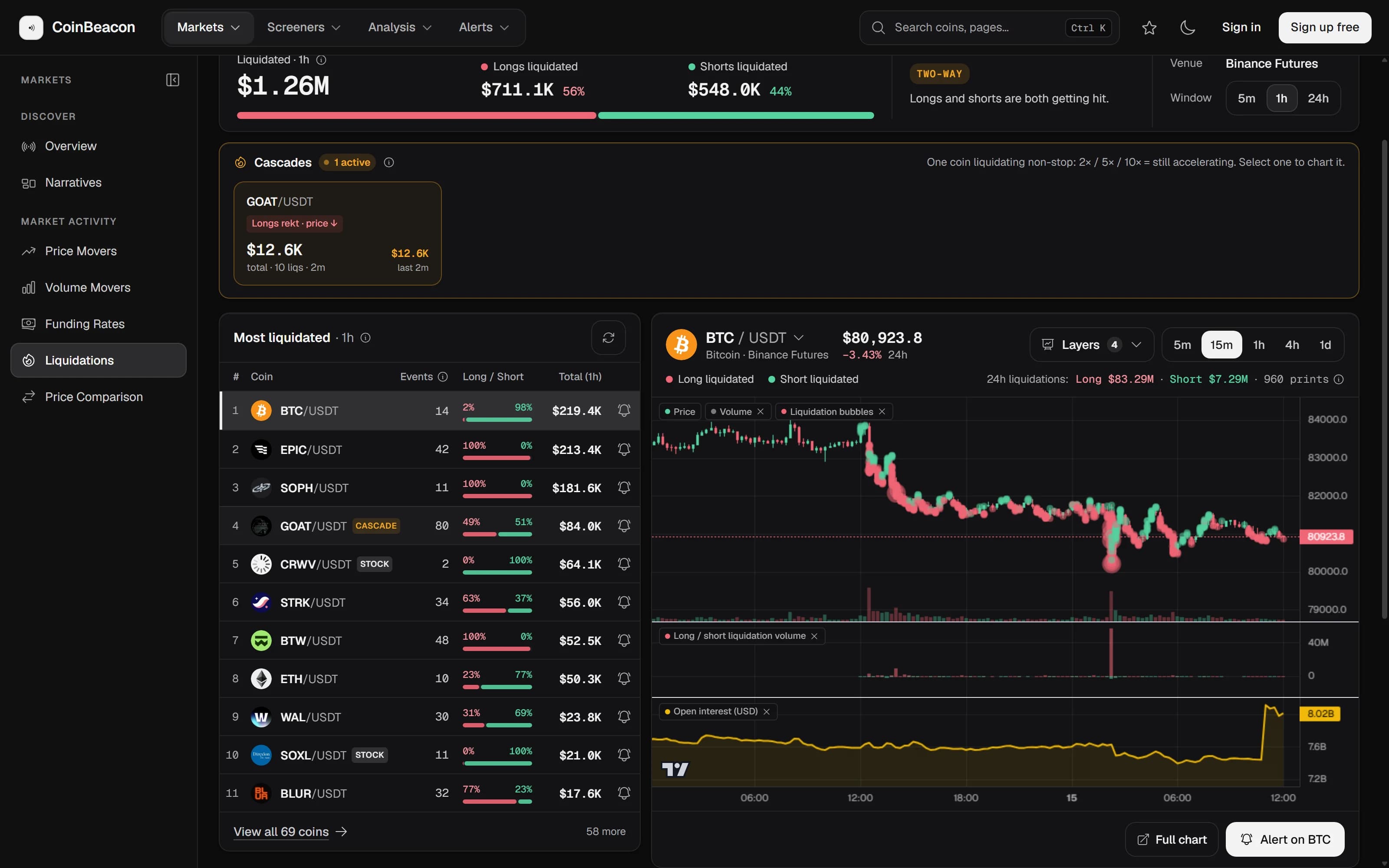
CoinBeacon watches each coin on each exchange separately. A cascade starts when, within a rolling two-minute window, a coin has both:
- Enough liquidations. Between 3 and 6, scaled up for coins with more trading.
- Enough money liquidated. 0.005% of the coin’s 24-hour trading volume, but never less than $10,000 or more than $250,000.
Scaling by volume keeps a large coin from cascading on routine noise and a small one from never registering. In practice, a coin trading $100 million a day needs 3 liquidations worth $10,000 inside two minutes; at $2 billion a day, 3 worth $100,000; at $10 billion, 5 worth $250,000.
- Its side comes from who is being closed. If at least 70% of the dollars are longs, it is a long cascade and the price is falling; at least 70% shorts makes it a short cascade with the price rising. Anything in between is mixed.
- It escalates as it grows. When the running total reaches 2, 5 and 10 times the amount that started it, the cascade is marked as escalating.
- It ends when the forced closes stop. A cascade is closed 60 seconds after its last qualifying two-minute window.
What the feeds can and cannot see
Liquidations come from the futures feeds of five exchanges: Binance, Bybit, OKX, Gate.io and HTX. None of them reports everything, and the gaps are not small:
- Binance sends at most one liquidation per coin per second. In a heavy cascade, many closes inside the same second arrive as one.
- OKX and Gate.io report a fraction. Measured against their own totals, OKX delivers about a third of its liquidation events and Gate.io about a sixth of the dollar volume. The money threshold is lowered on those two exchanges to match.
- Coin-margined Binance contracts are left out. Their contract sizes are not comparable with the dollar-margined ones.
Watching one happen
The public liquidations board shows Binance futures liquidations as they print, the cascades in progress, the most liquidated coins of the last 24 hours and a chart for each coin, all without an account. In the app, the Liquidations page covers all five exchanges, with 5-minute, 1-hour and 24-hour windows and a chart that marks each liquidation on the candles.
Getting alerted
A liquidation cascade alert tells you when a cascade starts on a coin you follow. It reads Binance futures only. Choose:
- A side. Any, Long or Short. A mixed cascade only matches Any.
- A minimum size. Any size, $100K, $500K, $1M, $5M or your own figure.
- Whether escalations count. On by default, so a cascade that doubles, then grows fivefold, tells you each time.
- A cooldown. 5, 15, 30 or 60 minutes, 15 by default.
The alert checks every minute, looking back over the last three, so the first check runs about two minutes after you create it. A cascade that starts and finishes inside your cooldown is missed rather than saved up for later. To hear about cascades on any coin, the scanner in Scan All Coins applies the same rules across the market.